Chronic illness, invisible illness, and energy limiting conditions (ELCs) – what’s the difference?
You may have heard people talk about their chronic illness, raise awareness for invisible illnesses, or come across references to energy limiting conditions, but what is the difference, and where is the overlap between them?
When working with people with these types of conditions, it’s important to know what is being referenced, as each term has its own nuance and foregrounds a particular experience, as well as there being considerable overlap.
Chronic illness
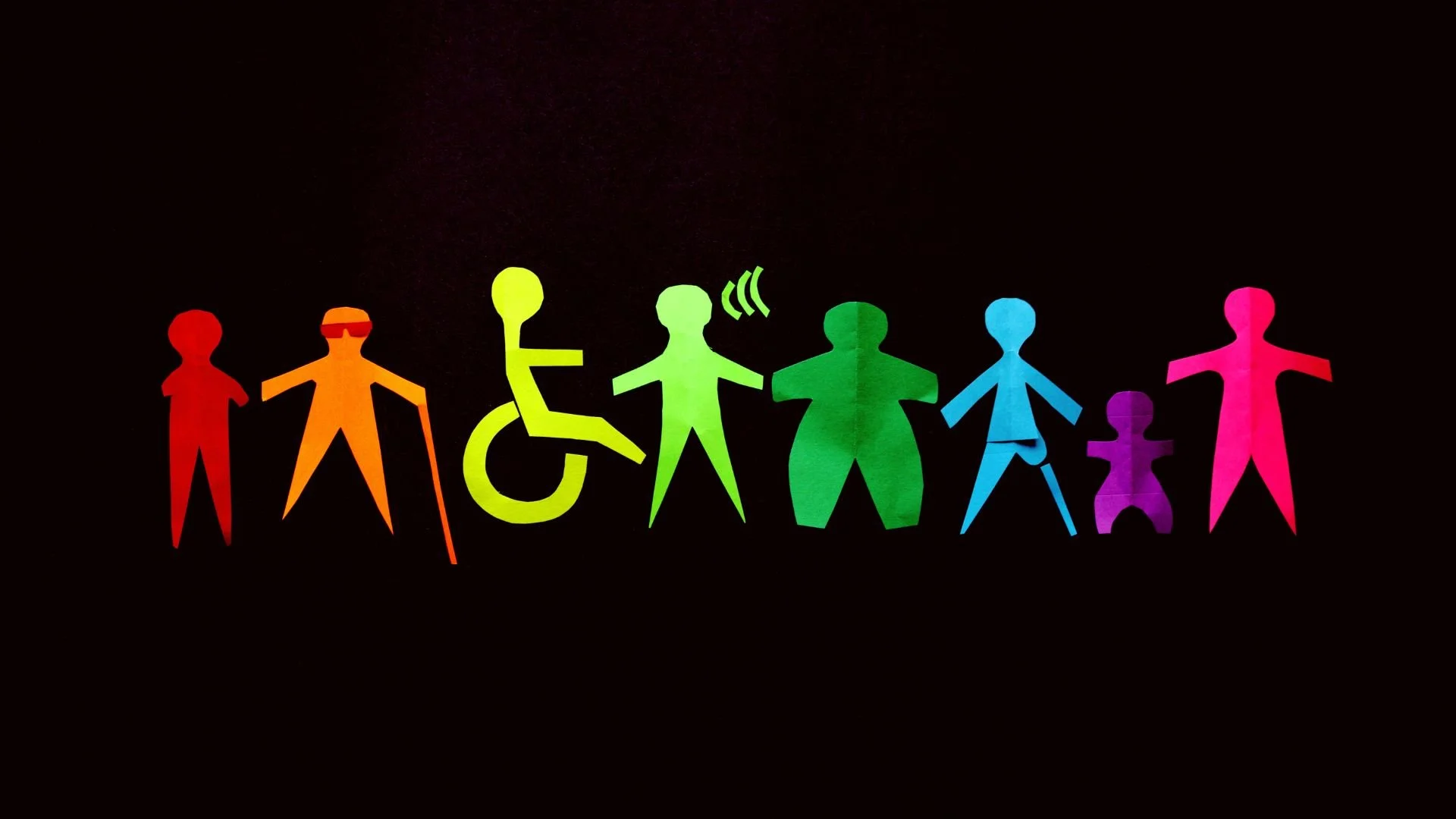
Rainbow coloured paper cutouts of people with different abilities and different abilites on a black background. Image by Katie Rainbow on Pexels
A research briefing for a debate on long term conditions held in the House of Commons on 12th June 2025 defines chronic illnesses as requiring management over a number of years, with no cure, but can often be controlled by medication or other types of treatment. Within this definition, it includes both communicable diseases (such as HIV), and non-communicable diseases (such as cancers, multiple sclerosis, and mental health conditions.)
Although the symptoms and causes of these conditions can vary, the National Institute for Health and Care Research identified “reduced mobility, chronic pain, shrinking social networks, losing the ability to engage with work as it is typically structured, and lower mental wellbeing” (2021) as regularly shared experiences of those with chronic illnesses.
Invisible illness
The Hidden Disabilities Charity defines invisible disabilities (or illnesses) as “a physical, mental, or neurological condition that is not visible from the outside, yet can limit or challenge a person’s movements, senses, or activities” (2025).
Chronic illnesses such as multiple sclerosis, lupus, and fibromyalgia often have what a Harvard Health article calls “wax-and-wane symptoms” (2023) in which people have periods of a relative reduction in symptoms and ‘flare ups’ in which symptoms increase in intensity and duration. This can contribute to the illusion of someone who is ‘fine’ one day, and bed-bound or using a wheelchair the next.
This lack of consistency in symptom intensity, combined with invisible symptoms such as chronic pain and chronic fatigue, can lead to discrimination on the basis that people with these illness ‘don’t look disabled’ and the belief that they are therefore faking it.
Energy limiting conditions
The term energy limiting conditions was coined by the Chronic Illness Inclusion Project (CIIP) as part of a report which “sets out the evidence for considering ELCI [energy limiting chronic illness] as a cohort of disabled people” in response to the misconception that fatigue is simply tiredness, and everyone experiences it.
The CIIP explored the ambiguous territory of people with chronic illnesses as part of the wider disabled community, and argued that their exclusion from this label prevents them from being able to challenge social and structural disadvantage as well as access the emancipatory power of the social model of disability.
These three labels for many overlapping conditions each highlight the different experiences, prejudices, and identities of people with long term health conditions. They take into account the medical and social factors that come to define these conditions, and each one recognises the psychological harm that can be experienced as a result of exclusion, discrimination, and disempowerment.
The experiences and identities of chronically ill people are complex, and as with any marginalised group, it is a mistake to generalise and assume homogeneity across the millions of people living with a chronic – or invisible or energy limiting – illness. However, these definitions and labels help to encapsulate the many medical, social, and societal forces at work on this group and the shared experiences that link this community together.
References
Chronic Illness Inclusion. (2023). Energy Limiting Conditions and disability - Chronic Illness Inclusion. [online] Available at: https://chronicillnessinclusion.org.uk/our-work/elci-energy-impairment-disability/.
Hale, C., Benstead, S., Lyus, J., Odell, E. and Ruddock, A. (2020). Energy Impairment and Disability Inclusion: Towards and advocacy movement for energy limiting chronic illness. Centre for Welfare Reform.
Hidden Disabilities. (n.d.). A - Z Hidden Disabilities. [online] Available at: https://www.hiddendisabilities.org.uk/hidden-disabilities/a-to-z-hidden-disabilities.
Imison, C. (2021). Making sense of the evidence: Multiple long-term conditions (multimorbidity). [online] NIHR Evidence. Available at: https://evidence.nihr.ac.uk/collection/making-sense-of-the-evidence-multiple-long-term-conditions-multimorbidity/.
Rough, E., Duddy, C., Sutherland, N., Kennedy, S. and Andrew Powell (2025). Debate on long-term conditions. London: House of Commons Library.
Salamon, M. (2023). Invisible illness: More than meets the eye. [online] Harvard Health. Available at: https://www.health.harvard.edu/diseases-and-conditions/invisible-illness-more-than-meets-the-eye.